
Barrel saunas are one of the most recognizable outdoor sauna designs, using curved walls and interlocking wood staves to create a compact sauna that fits well in many backyards. They’re available in sizes ranging from small two-person models to larger saunas with changing areas and covered porches.
This guide explains how barrel saunas work, what they cost, foundation and electrical requirements, heater options, sizing and the most important things to consider before buying one for your home.
What Is a Barrel Sauna?
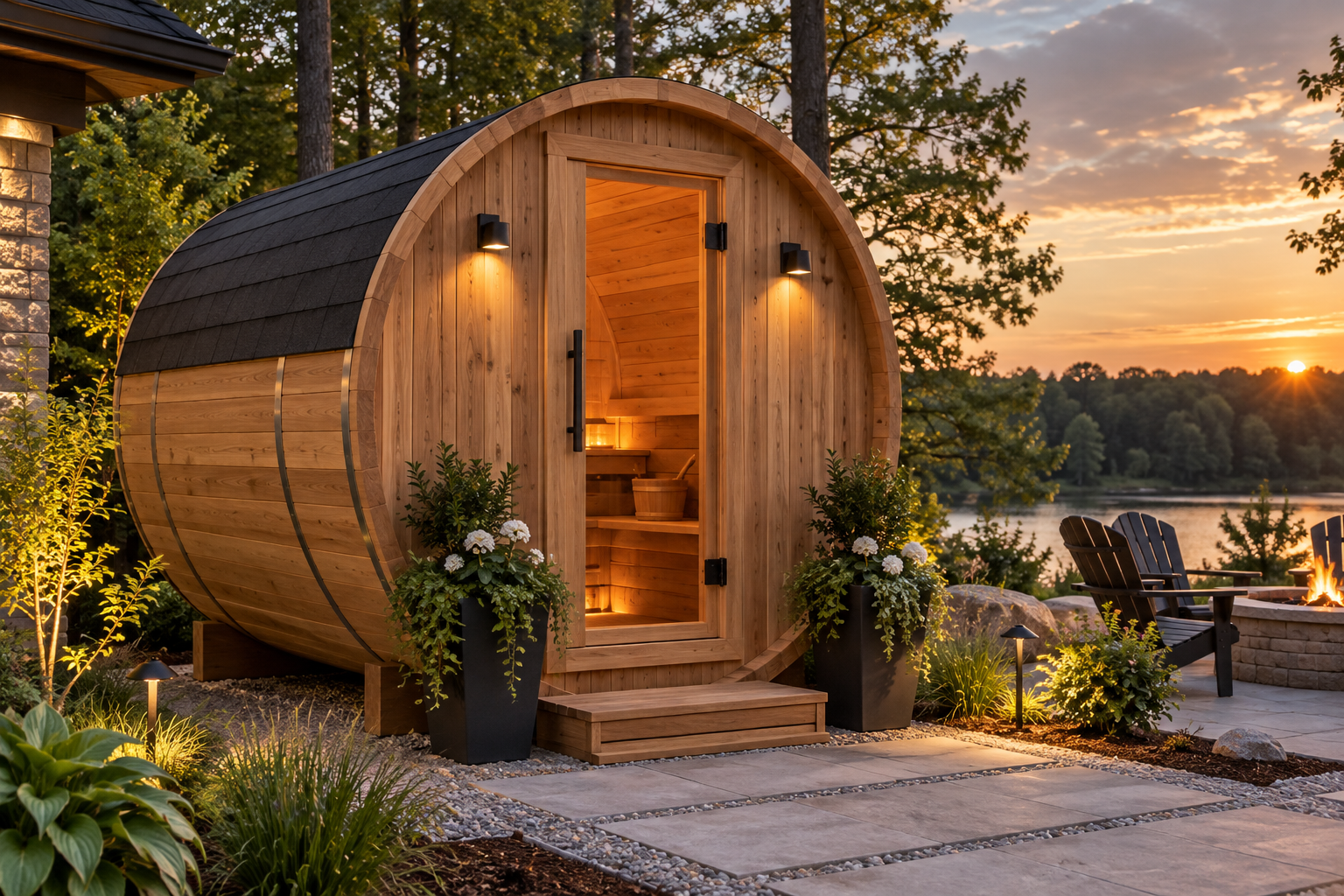
A barrel sauna is an outdoor sauna built in the shape of a large wooden barrel. Instead of using conventional framed walls and a flat or pitched ceiling, curved wood staves form both the walls and roof of the sauna. Metal bands wrap around the exterior and help hold the staves tightly together.
The rounded design gives barrel saunas their distinctive appearance, but it also serves a practical purpose. Because there is less interior air space above the benches than in many rectangular sauna rooms, a properly sized heater can warm the space efficiently.
Most barrel saunas are sold as prefabricated kits and assembled on a prepared foundation or base. Common models accommodate anywhere from two to six or more people, with larger designs sometimes including a covered porch or small changing area.
Barrel saunas can use either electric or wood-burning heaters, allowing homeowners to choose between the convenience of electric heat and the more traditional experience of a wood-fired sauna.
How Do Barrel Saunas Work?
Barrel saunas work much like other traditional saunas. An electric or wood-burning heater warms the sauna room and a bed of sauna stones positioned above the heater. As the room heats, the stones store heat and help maintain the high temperatures associated with a traditional sauna.
Water can be poured over the heated stones to create löyly—a temporary burst of steam that raises the perceived heat and humidity inside the sauna. Between these bursts, the sauna remains relatively dry compared with a steam room.
The curved interior of a barrel sauna reduces unused space near the ceiling compared with many conventional rectangular rooms. Hot air also circulates through the compact interior as the sauna warms.
However, the curved shape creates an important design tradeoff: bench height is limited. In many barrel saunas, the benches sit relatively low because the walls begin curving inward. Since hotter air naturally collects higher in the room, bench position and heater placement can have a noticeable effect on the sauna experience.
This is one reason to look beyond exterior appearance when comparing barrel saunas. The interior diameter, bench height, heater size and ventilation design can matter just as much as the overall length of the barrel.
Barrel Sauna Sizes and Capacity
Barrel saunas are available in several sizes, from compact two-person models to larger designs intended for six or more people. When comparing sizes, don’t rely entirely on the advertised person capacity. Manufacturers may calculate capacity based on how many people can sit side by side, which can feel crowded in actual use.
The diameter and length of the barrel determine most of the usable interior space. Larger diameters generally provide more headroom and can allow better bench positioning, while additional length provides more seating space.
| Advertised Capacity | Typical Barrel Length | Good For |
| 2-person | About 4–5 ft | Couples or very limited spaces |
| 4-person | About 5–6 ft | 2–4 regular users |
| 6-person | About 6–8 ft | Families or additional seating |
| 6+ person | 8 ft+ | Larger groups or added interior space |
These dimensions are general planning ranges because barrel sauna designs vary considerably between manufacturers. Some models also use part of their overall length for a porch, changing area or other feature rather than sauna-room seating.
For most buyers, it’s better to choose based on usable bench length and interior dimensions rather than the capacity number in the product name. If you expect two people to use the sauna regularly, for example, a four-person model may provide a much more comfortable amount of space than a compact two-person barrel.
Also consider whether you want enough bench length to lie down. A sauna may comfortably seat several people while still being too short for an adult to stretch out on the bench.
If you’re unsure how much room you need, our Sauna Size Guide explains typical bench dimensions, ceiling height, room volume and other space-planning considerations.
How Much Does a Barrel Sauna Cost?
Barrel saunas are often less expensive than large custom outdoor saunas, but prices vary considerably depending on size, wood species, heater, windows and included features. For initial planning, most barrel sauna kits fall somewhere around $4,000–$10,000+.
The sauna itself isn’t necessarily the entire project cost. You may also need to budget for a prepared foundation, electrical work, delivery and professional assembly. A reasonable planning range for a complete barrel sauna project is about $5,000–$15,000+.
| Cost Item | Typical Range |
| Barrel sauna / kit | $4,000–$10,000+ |
| Foundation / site preparation | $500–$3,000+ |
| Electrical work | $500–$2,500+ |
| Professional assembly / installation | $500–$3,000+ |
| Delivery / freight | $200–$2,000+ |
| Typical complete project | $5,000–$15,000+ |
These are general planning ranges, and not every project will require every expense. A homeowner assembling a kit on an existing suitable base with electrical service nearby may spend considerably less than someone who needs a new foundation, a long electrical run and professional installation.
Pay particular attention to what is included in the advertised price. Some barrel sauna packages include the heater, controls and roofing materials, while others sell those components separately. Delivery charges can also vary significantly because of the size and weight of sauna materials.
When comparing models, calculate the expected installed cost, not simply the price displayed for the sauna kit.
For a broader comparison of sauna prices and installation expenses, see our Home Sauna Cost guide.
Barrel Sauna Foundation Requirements
A barrel sauna needs a level, stable and well-drained base. Although barrel saunas are often smaller and lighter than cabin-style outdoor saunas, the foundation still needs to support the structure without shifting or settling over time.
The wooden support cradles underneath the barrel transfer the sauna’s weight to the base. If those supports aren’t level, the barrel can sit unevenly, which may affect the door, wood staves and overall structure.
- Concrete slab — A durable, level option for permanent installations.
- Concrete pavers — Can work well for many barrel saunas when installed over a properly prepared and compacted base.
- Compacted gravel — A practical option for some models when contained, leveled and prepared for good drainage.
- Concrete footings or piers — May be appropriate depending on the sauna design, site and local conditions.
- Existing patio or deck — Potentially usable if it can safely support the sauna and meets the manufacturer’s installation requirements.
For a real-world example, Almost Heaven Saunas recommends installing its barrel saunas on a level, solid surface rather than directly on bare ground and discusses concrete, pavers, platforms and compacted gravel as possible base materials.
Avoid placing a barrel sauna directly on grass, loose soil or an uneven surface. The sauna needs to remain level, and good drainage helps prevent persistent moisture from collecting underneath the wood supports.
Also remember that the advertised dimensions of the sauna aren’t necessarily the only space you need. Leave enough room around the structure for assembly, maintenance, roof or exterior access and safe entry through the door.
Before building the foundation, use the exact dimensions and support locations specified by the sauna manufacturer. Local requirements for accessory structures, setbacks and foundations may also apply.
Electric vs. Wood-Burning Barrel Sauna Heaters
Most barrel saunas use either an electric sauna heater or a wood-burning sauna stove. Both can provide the high-temperature, stone-heated experience of a traditional sauna, but they create very different installation and ownership considerations.
Electric Barrel Sauna Heaters
Electric heaters are the most convenient option for many residential barrel saunas. Once properly installed, you can turn on the heater and allow the sauna to warm without starting or tending a fire.
The main consideration is electrical service. Many barrel sauna heaters operate on 240V power and require a dedicated circuit, with the exact electrical requirements determined by the heater model and manufacturer.
If the barrel sauna will be located a considerable distance from your electrical panel, the longer wiring run can increase installation cost. This is worth determining before purchasing the sauna rather than discovering it after delivery.
Wood-Burning Barrel Sauna Heaters
A wood-burning heater provides a more traditional fire-heated sauna experience and can be particularly attractive for rural properties or locations where bringing substantial electrical service to the sauna would be difficult.
The tradeoff is additional installation and maintenance. A wood-burning sauna requires a properly installed stove and chimney system, appropriate clearances and fire protection, as well as a supply of dry firewood. Installation must follow the heater and chimney manufacturers’ requirements and applicable local building and fire-safety rules.
With either heater type, sauna stones are heated above the heat source. Water can be poured over the hot stones to produce löyly, creating short bursts of steam and increased perceived heat.
For most homeowners, electric heat wins on convenience, while wood-burning heat offers the experience of tending a real fire. Neither is automatically the better choice—the property, installation requirements and way you plan to use the sauna should determine the decision.
If you’re considering an electric model, review our Sauna Electrical Requirements guide before buying so you understand dedicated circuits, 240V power and electrical-panel considerations.
Barrel Sauna Heater Sizing
Choosing the correct heater size is important in any sauna, but barrel saunas have a slightly different interior shape than conventional rectangular sauna rooms. Heater selection should be based on the actual heated volume of the sauna and the heater manufacturer’s sizing recommendations, rather than simply the advertised number of people the sauna can hold.
As a general planning guideline for traditional electric saunas, roughly 1 kW of heater capacity for every 45–50 cubic feet of sauna space is a useful starting point.
| Sauna Room Volume | Typical Heater Size |
| Up to 250 cu. ft. | 4.5–6 kW |
| 250–350 cu. ft. | 6–8 kW |
| 350–500 cu. ft. | 8–10.5 kW |
| 500–650 cu. ft. | 10.5–12 kW |
These ranges are for initial planning only. The final heater selection should follow the heater manufacturer’s specifications for the particular sauna.
Glass can make a significant difference. Full-glass doors, panoramic windows and other uninsulated surfaces lose more heat than insulated wood walls. Manufacturers may require additional calculated room volume to compensate for these surfaces when sizing the heater.
Don’t automatically choose a larger heater because you want the sauna to heat faster. Sauna heaters are designed to operate within a specified room-volume range, and an oversized heater isn’t a substitute for proper sizing.
Why Barrel Diameter Matters
Two barrel saunas with similar lengths can have different interior volumes if their diameters are different. A larger-diameter barrel provides more headroom and usable interior space, but it also increases the amount of air the heater must warm.
Diameter can also affect bench position relative to the heater and ceiling. Because heat naturally rises, a larger barrel that allows the benches to sit higher may provide a different bathing experience than a smaller barrel with low benches.
When comparing models, look at the interior dimensions, calculated sauna volume, bench height and recommended heater range rather than choosing solely by exterior dimensions or advertised seating capacity.
Barrel Sauna Roofing and Weather Protection
One of the most important differences between barrel saunas is how they handle rain, sun and long-term exposure to the weather. The curved wood staves form the sauna walls and roof, but that doesn’t necessarily mean the bare wood exterior should be treated as a complete roofing system in every climate.
Water naturally runs down the curved sides of a barrel sauna, but repeated exposure to rain and moisture can still affect the wood over time. The top of the barrel is especially important because it receives the most direct exposure to rain and sunlight.
Does a Barrel Sauna Need a Roof?
Some barrel sauna manufacturers design their models to remain outdoors with exposed wood, while others recommend or include shingles, a waterproof membrane or another roof covering over the upper portion of the barrel.
Follow the manufacturer’s instructions for the specific sauna rather than assuming every barrel sauna should be treated the same way. Adding an unapproved covering can potentially interfere with ventilation, moisture movement or warranty requirements.
Protecting the Exterior Wood
Exterior wood will naturally change appearance as it is exposed to sunlight and weather. Depending on the wood species and manufacturer recommendations, an appropriate exterior treatment may help maintain the appearance of the sauna and protect exposed surfaces.
Pay particular attention to end walls, door and window openings, support cradles and areas where water may collect. Good site drainage is just as important as protecting the wood itself because standing water beneath the sauna can keep the lower portions of the structure damp.
Avoid applying ordinary exterior paints, stains or sealers to the interior sauna surfaces unless the sauna manufacturer specifically approves the product for that use. Interior sauna wood is exposed to high temperatures and should be maintained according to the manufacturer’s recommendations.
Barrel Sauna Maintenance
Barrel saunas are relatively simple structures, but their exposed wood construction means regular inspection is important. Most maintenance involves keeping the sauna clean and dry, protecting the exterior from weather and checking the wood staves, metal bands and heater periodically.
After using the sauna, allow the interior to ventilate and dry thoroughly. Moisture left inside repeatedly can contribute to staining, odors and deterioration over time.
For routine maintenance, check:
- Benches and interior wood — Keep them clean and allow them to dry after use.
- Sauna stones — Inspect them periodically and replace deteriorated stones according to the heater manufacturer’s recommendations.
- Exterior wood — Check for weathering, cracks or areas that remain damp.
- Roof or weather covering — Inspect shingles, membranes or other coverings for damage.
- Doors and windows — Make sure they continue to close and seal properly.
- Foundation and drainage — Keep leaves, soil and standing water away from the sauna supports.
- Heater — Follow the manufacturer’s inspection and maintenance instructions.
- Chimney system — Wood-burning models require appropriate chimney inspection and maintenance.
Do Barrel Sauna Bands Need Tightening?
Barrel saunas are commonly held together by stainless-steel bands wrapped around the wood staves. Because wood naturally expands and contracts as moisture and weather conditions change, the fit of the staves and tension of the bands can change over time.
Some manufacturers instruct owners to inspect or adjust band tension periodically, particularly after initial assembly or seasonal changes. However, don’t simply tighten the bands as much as possible. Excessive tension can potentially damage the wood or hardware.
Follow the specific sauna manufacturer’s instructions for checking and adjusting the bands. Small changes in the wood are normal, but persistent gaps, water intrusion or structural movement should be investigated rather than corrected by indiscriminately tightening the hardware.
Will a Barrel Sauna Wood Crack?
Some checking—small cracks that develop as wood expands and contracts—can occur naturally in outdoor wood products and doesn’t necessarily indicate a structural problem. The amount varies with the wood species, climate and exposure.
Larger openings, significant separation between staves or areas that allow substantial water intrusion deserve closer attention. Good drainage, appropriate weather protection and following the manufacturer’s exterior-maintenance recommendations can help protect the structure.
Barrel Sauna vs. Cabin Sauna
Barrel saunas and cabin saunas can provide the same traditional high-temperature sauna experience, but their shapes create meaningful differences in interior space, bench layout, weather protection and appearance.
A barrel sauna uses curved wood staves to create a compact structure with relatively little unused interior space. A cabin sauna uses conventional straight walls and a roof, providing more flexibility for bench heights, windows, insulation and interior layouts.
| Feature | Barrel Sauna | Cabin Sauna |
| Shape | Rounded barrel | Rectangular structure |
| Interior space | Compact, curved walls | More usable wall and ceiling space |
| Bench layout | More limited by curved walls | Greater layout flexibility |
| Upper benches | Often limited | Easier to incorporate |
| Assembly | Many models sold as kits | Kits and fully constructed models available |
| Insulation | Often limited or none | More commonly available |
| Weather protection | Varies by model; roof covering may be needed | Conventional roofing system |
| Appearance | Distinctive barrel design | Traditional building appearance |
| Heater options | Electric or wood-burning | Electric or wood-burning |
| Best fit | Compact backyard sauna | Larger or more flexible sauna space |
Which Is Better: Barrel or Cabin Sauna?
A barrel sauna can be a good choice when you want a relatively compact outdoor sauna, like the distinctive appearance and prefer a kit that can often be assembled on-site.
A cabin sauna may be better when interior layout is a priority. Straight walls and greater ceiling height make it easier to create multiple bench levels, provide more headroom and incorporate features such as large windows, changing areas or additional seating.
Climate can also influence the decision. Buyers in particularly cold or wet locations should pay close attention to insulation, roofing and weather protection rather than choosing based only on shape.
Neither design is inherently better for everyone. Compare the usable interior dimensions, bench heights, heater specifications and construction details of the actual models you’re considering.
Pros and Cons of Barrel Saunas
Barrel saunas have become popular because they combine the traditional sauna experience with a distinctive design that works well in many backyards. But the curved construction also creates tradeoffs that are worth understanding before you buy.
Advantages of a Barrel Sauna
- Compact design — The rounded shape uses relatively little space compared with many larger outdoor sauna structures.
- Distinctive appearance — A cedar barrel sauna can become an attractive feature in a backyard, pool area or lakeside setting.
- Available as kits — Many models are designed for on-site assembly, which can reduce construction requirements compared with a custom-built sauna.
- Less unused interior volume — The curved ceiling reduces some of the air space found above the benches in taller rectangular rooms.
- Multiple heater choices — Models are available with both electric and wood-burning heaters.
- Wide range of sizes — Options range from compact two-person models to larger barrels with porches and changing areas.
Disadvantages of a Barrel Sauna
- Limited bench height — Curved walls can prevent benches from being positioned as high as they can in a well-designed cabin sauna.
- Less interior flexibility — The curved shape limits shelving, bench arrangements and other interior features.
- Weather exposure — Exterior wood and the upper portion of the barrel need appropriate protection for the climate and sauna design.
- Limited insulation in some models — Many traditional barrel kits rely primarily on their wood staves rather than insulated framed walls.
- Wood movement — Staves naturally expand and contract as moisture and weather conditions change, making periodic inspection important.
- Less headroom near the sides — The curved walls reduce usable standing and sitting space toward the edges of the sauna.
The biggest tradeoff is really simplicity versus interior flexibility. A well-designed barrel sauna can provide an excellent traditional sauna experience in a relatively compact structure, but buyers who prioritize high benches, maximum headroom, extensive insulation or a more elaborate interior may prefer a cabin-style sauna.
What to Look for When Buying a Barrel Sauna
Barrel saunas can look very similar in product photos while differing considerably in construction, interior space and what is actually included in the purchase price. Before comparing brands, focus on the specifications that affect how the sauna will perform and what the complete installation will require.
- Interior diameter and dimensions — Check the usable interior measurements rather than relying only on advertised capacity.
- Bench dimensions and height — Look for enough bench length and depth for the way you expect to use the sauna, and pay attention to how high the benches sit within the barrel.
- Wood species and stave construction — Compare the wood used, stave thickness and how the barrel is assembled.
- Heater size — Make sure the included or recommended heater is properly matched to the sauna’s calculated volume.
- Electric vs. wood-burning heat — Determine which heater type makes sense for your property before choosing the sauna.
- Windows and glass — Panoramic windows can dramatically change the appearance but may also increase heat loss and heater-sizing requirements.
- Weather protection — Find out whether shingles, a membrane or another roof covering is included or recommended.
- Foundation requirements — Know the size and type of base you’ll need before the sauna arrives.
- Electrical requirements — For electric models, determine voltage, circuit and installation requirements before purchasing.
- Ventilation — Check how the sauna manufacturer handles air intake and exhaust ventilation.
- What’s included — Determine whether the advertised price includes the heater, stones, controls, lighting, roofing materials and other accessories.
- Delivery and assembly — Find out whether the sauna arrives as a kit, partially assembled or fully assembled and where the carrier will actually unload it.
- Warranty and support — Compare coverage for the sauna structure, heater and other components, as well as the availability of replacement parts and technical support.
Don’t Buy Based on Capacity Alone
A sauna advertised as a six-person barrel sauna doesn’t necessarily mean six adults will find it comfortable. Look at the actual bench length and interior dimensions and think about how many people will regularly use the sauna.
If two people will use it most of the time, buying a somewhat larger model can provide additional elbow room and may allow one person to stretch out along a bench.
Compare the Complete Package Price
A low advertised price isn’t necessarily a better value. One barrel sauna may include the heater, stones, controls and weather protection, while another requires those items to be purchased separately.
Before comparing prices, build a rough complete-project cost that includes the sauna, heater, foundation, electrical work, delivery and assembly. That provides a much more useful comparison than the kit price alone.
Is a Barrel Sauna Right for You?
A barrel sauna can be an excellent choice if you want a traditional outdoor sauna experience in a relatively compact, distinctive structure. They’re particularly appealing for homeowners who want a backyard sauna without constructing a full cabin-style building.
Barrel saunas work especially well when you have a suitable outdoor location, are comfortable preparing a proper foundation and don’t need the interior flexibility of a larger rectangular sauna.
A barrel sauna may be a good fit if you:
- Want a dedicated outdoor sauna without using interior living space
- Like the distinctive curved barrel design
- Prefer traditional high-temperature sauna heat
- Want the option of electric or wood-burning heat
- Have room for a properly prepared outdoor base
- Prefer a prefabricated kit over custom sauna construction
- Don’t require elaborate bench layouts or a large changing area
A barrel sauna may be less appealing if high bench placement, maximum headroom or extensive insulation are priorities. In those situations, a well-designed cabin sauna may provide greater flexibility.
Climate matters as well. If you live somewhere with heavy rain, snow or prolonged cold temperatures, pay particularly close attention to the sauna’s roofing, insulation, wood construction and weather-protection requirements.
Before ordering, confirm the sauna’s actual interior dimensions, heater specifications, foundation requirements, electrical needs and what is included with delivery. Those details will tell you much more than the advertised seating capacity alone.
Barrel Sauna FAQs
How much does a barrel sauna cost?
Barrel sauna kits commonly cost around $4,000–$10,000+. After foundation work, electrical installation, delivery and assembly are considered, a complete project may cost approximately $5,000–$15,000+. Premium models and larger installations can cost more.
Do barrel saunas need a foundation?
Yes. A barrel sauna needs a stable, level and well-drained base. Depending on the model and site, this might be a concrete slab, properly installed pavers, compacted gravel or another foundation approved by the sauna manufacturer.
Can a barrel sauna stay outside year-round?
Barrel saunas designed for outdoor installation can remain outside year-round, but appropriate weather protection and maintenance are important. Follow the manufacturer’s recommendations for roofing, exterior wood treatment and drainage.
Are barrel saunas good in cold climates?
They can be used in cold climates, but construction details become especially important. Heater sizing, wood thickness, glass area, weather protection and insulation—when included—can all affect performance during very cold weather.
How long does a barrel sauna take to heat up?
Warm-up time varies with the sauna’s size, heater output, outdoor temperature, construction and amount of glass. A traditional barrel sauna may take roughly 30–60 minutes or longer to reach bathing temperature, particularly during cold weather.
Is an electric or wood-burning heater better for a barrel sauna?
Electric heaters generally provide greater convenience and simpler day-to-day operation. Wood-burning heaters provide a more traditional fire-heated experience and can make sense where substantial electrical service would be difficult to install. The better choice depends on your property and how you plan to use the sauna.
Do barrel saunas leak?
A properly assembled barrel sauna is designed for outdoor use, but the wood naturally expands and contracts as moisture conditions change. Weather protection varies between manufacturers, and some recommend shingles or another covering over the upper portion of the barrel. Persistent water intrusion should be addressed rather than assumed to be normal.
How long do barrel saunas last?
There isn’t one reliable lifespan for every barrel sauna. Wood species, construction quality, climate, drainage, weather protection and maintenance all affect longevity. Keeping the sauna properly supported, allowing it to dry and addressing exterior or roofing problems early can help extend its useful life.
Ready to Choose a Barrel Sauna?
Before comparing specific models, decide how many people will regularly use the sauna, where it will be installed and whether you prefer electric or wood-burning heat. Then compare models based on usable interior space, heater sizing, construction, weather protection and complete installed cost rather than appearance alone.