
Infrared saunas use infrared heating panels to warm your body directly rather than relying primarily on extremely hot air to heat the sauna room. They typically operate at lower temperatures than traditional saunas, warm up relatively quickly and can be easier to install in a home.
This guide explains how infrared saunas work, what they cost, their electrical and space requirements, and how they compare with traditional saunas so you can decide whether an infrared sauna is right for your home.
What Is an Infrared Sauna?
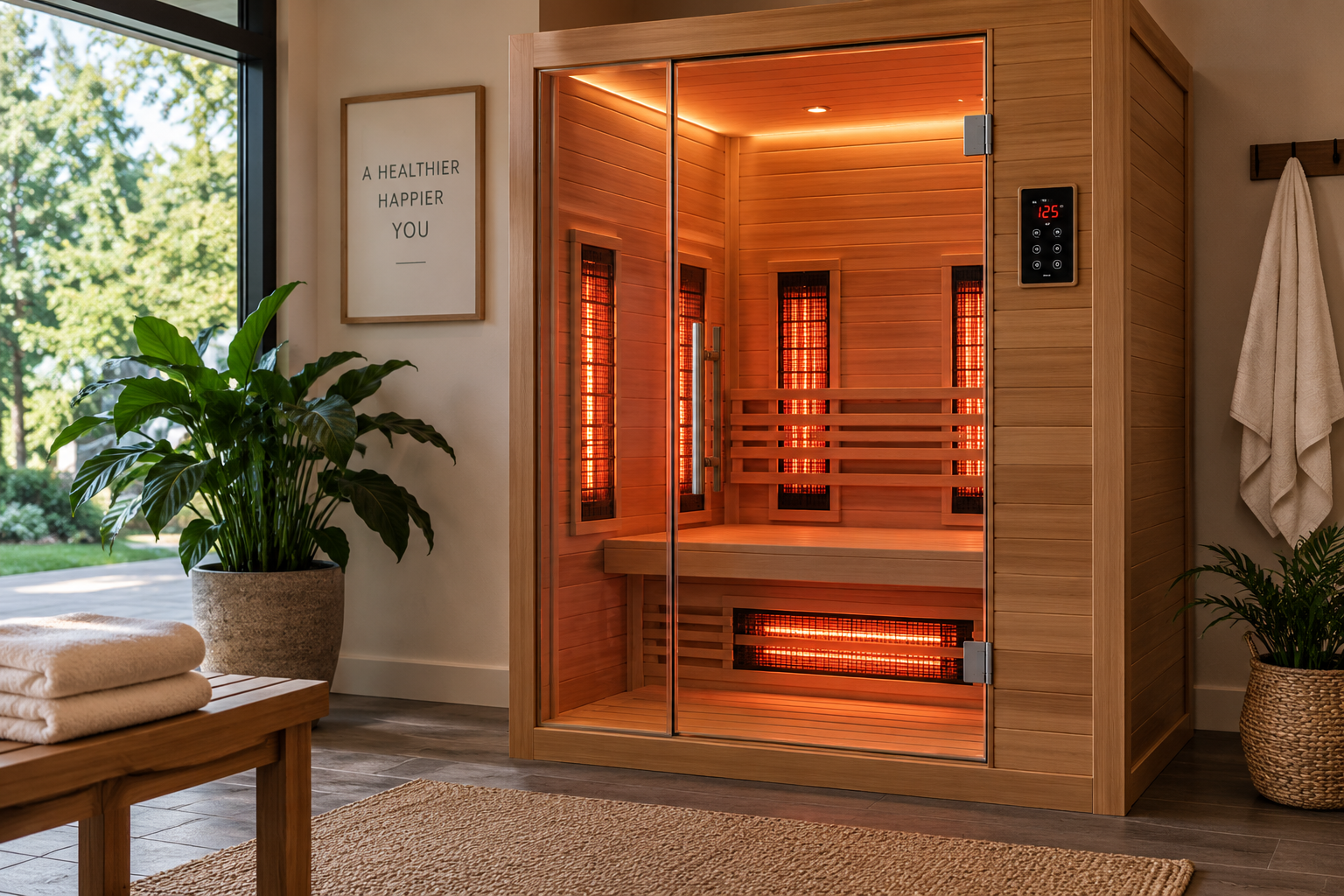
An infrared sauna is a type of sauna that uses infrared heating panels instead of a traditional sauna heater and hot stones. The panels emit infrared energy that warms your body and the surfaces inside the sauna while also raising the temperature of the surrounding air.
Most infrared saunas operate at lower air temperatures than traditional saunas, commonly around 110°F to 150°F. Traditional saunas typically operate closer to 150°F to 195°F. Because infrared saunas do not need to heat the room to the same temperature, they can usually warm up faster and may use smaller electrical circuits.
Infrared saunas are commonly sold as prefabricated indoor cabins for one to four people. Many models arrive as panelized kits that can be assembled inside a home, which can make installation simpler than building a traditional sauna room.
How Do Infrared Saunas Work?
Infrared heaters produce electromagnetic energy in wavelengths that are absorbed by your skin and other surfaces inside the sauna. Instead of relying primarily on very hot air to transfer heat to your body, infrared energy delivers radiant heat directly.
This is similar to the way you can feel warmth from sunlight even when the surrounding air is cool. In an infrared sauna, however, the heating panels are designed to produce infrared energy without the ultraviolet radiation associated with sunlight.
The lower operating temperature is one of the main reasons people choose infrared saunas. You can still experience substantial warmth and sweating without heating the room to the higher temperatures typically associated with a traditional sauna.
Near-, Mid- and Far-Infrared Saunas
Infrared energy covers a range of wavelengths, and sauna manufacturers commonly describe their heaters as near-infrared, mid-infrared or far-infrared. Some saunas use primarily far-infrared heaters, while others are marketed as full-spectrum saunas that produce multiple infrared wavelengths.
Near-Infrared
Near-infrared has the shortest wavelengths of the three categories. Some sauna manufacturers use near-infrared lamps or heating elements as part of a full-spectrum system. You may see claims that near-infrared provides specific health benefits, but those claims should be evaluated separately from the basic heating function of the sauna.
Mid-Infrared
Mid-infrared falls between near- and far-infrared wavelengths. It is less commonly used as the primary heating technology in residential infrared saunas, although it may be included in models marketed as full-spectrum systems.
Far-Infrared
Far-infrared is the most common type used in residential infrared sauna cabins. Far-infrared panels are typically installed in the walls, behind the seating area and sometimes beneath or around the legs to provide radiant heat throughout the cabin.
Don’t assume that a “full-spectrum” sauna is automatically better than a far-infrared sauna. Heater placement, power, cabin design, build quality, electrical requirements and warranty can be more useful buying considerations than the number of infrared wavelength categories listed in the marketing materials.
Infrared Sauna Electrical Requirements
One of the advantages of many infrared saunas is that their electrical requirements can be simpler than those of traditional electric saunas. Smaller infrared models may operate on 120V power, while larger cabins and higher-output models may require a dedicated 240V circuit.
Don’t assume that a sauna can use an existing household outlet simply because it is advertised as 120V. Some models require a dedicated circuit even when they use a standard-style plug. Always check the manufacturer’s electrical specifications for the exact sauna before purchasing it.
| Infrared Sauna Size | Common Electrical Setup |
| 1-person | Often 120V |
| 2-person | Often 120V; some require dedicated circuits |
| 3-4 person | 120V or 240V depending on model |
| Larger / high-output models | Often 240V |
These are general planning guidelines only. The required voltage, circuit, breaker and wiring depend on the specific sauna model and must follow the manufacturer’s installation instructions and applicable electrical requirements.
Before buying an infrared sauna, check the available electrical service in the room where you plan to install it. Our Sauna Electrical Requirements guide explains dedicated circuits, 120V vs. 240V power, electrical-panel capacity and other installation considerations in more detail.
How Much Does an Infrared Sauna Cost?
Infrared saunas are generally one of the more affordable ways to add a sauna to a home. Smaller one- and two-person models can start around $1,500–$3,000, while larger or premium infrared saunas commonly cost $4,000–$6,000 or more.
Installation costs can be relatively low when the sauna arrives as a prefabricated kit and the installation location already has suitable electrical service. Costs can increase if you need a new dedicated circuit, electrical-panel work or other preparation before the sauna can be installed.
| Cost Item | Typical Range |
| Infrared sauna | $1,500–$6,000+ |
| Electrical work | $0–$2,500+ |
| Professional assembly / installation | $0–$1,500+ |
| Delivery / freight | $0–$1,000+ |
| Typical complete project | $2,000–$8,000+ |
These are general planning ranges rather than quotes. Some infrared saunas include delivery or are designed for homeowner assembly, while premium models can exceed these ranges. Before comparing prices, check what is included with the sauna and whether your installation location needs electrical work.
For a broader comparison of infrared, traditional, outdoor and barrel sauna prices, see our Home Sauna Cost guide.
Infrared Sauna Size and Space Requirements
Infrared saunas are commonly sold as prefabricated cabins, so choosing the right size is usually a matter of matching the sauna’s exterior dimensions to the available space in your home. Compact one-person models can fit into relatively small areas, while larger three- and four-person cabins require considerably more floor space.
Don’t choose a sauna based only on its advertised person capacity. A “two-person” infrared sauna may feel comfortable for one person but tight for two adults, especially if you want room to stretch out. Compare the actual interior and exterior dimensions before buying.
| Infrared Sauna Size | Typical Planning Footprint |
| 1-person | About 3 ft × 3 ft |
| 2-person | About 4 ft × 4 ft |
| 3-person | About 5 ft × 4 ft |
| 4-person | About 6 ft × 4 ft or larger |
These dimensions are general examples rather than standard sizes. Actual dimensions vary by manufacturer and model, and additional clearance may be required around the sauna for ventilation, electrical access, doors or manufacturer-specified installation clearances.
Measure the installation area carefully before ordering and check the sauna’s assembled dimensions—not just its interior dimensions. Also consider ceiling height, doorway clearance and the path the sauna components will take through your home during installation.
Our Sauna Size Guide covers room dimensions, measuring your space and other planning considerations in more detail.
Where Can You Install an Infrared Sauna?
Infrared saunas are often easier to place inside a home than traditional saunas because most models are self-contained cabins and do not require a separate sauna room. Depending on the model and its electrical requirements, an infrared sauna may work in a bedroom, home gym, finished basement or other suitable indoor space.
The installation area should have a level, stable floor, adequate space around the sauna and access to the electrical service required by the manufacturer. You should also make sure there is enough room for the sauna door to open fully and enough clearance to assemble or service the unit.
Suitable locations can include:
- Finished basements
- Home gyms
- Large bedrooms
- Dedicated wellness rooms
- Suitable finished garages
- Other conditioned indoor spaces permitted by the manufacturer
Be more cautious with garages, bathrooms, covered patios and other areas that may experience high humidity, freezing temperatures or large temperature swings. A sauna that is designed for indoor use should not automatically be treated as suitable for outdoor or unconditioned installation. Always follow the manufacturer’s location and environmental requirements.
If you want a sauna that will remain permanently outside, choose a model specifically designed and constructed for outdoor use rather than placing a standard indoor infrared cabin outdoors.
Infrared Sauna vs. Traditional Sauna
Infrared and traditional saunas can both provide a hot, relaxing sauna experience, but they produce heat differently. An infrared sauna uses radiant heating panels and generally operates at a lower air temperature, while a traditional sauna uses an electric or wood-burning heater to heat the room and sauna stones.
| Feature | Infrared Sauna | Traditional Sauna |
| Heat source | Infrared heating panels | Electric or wood-burning heater |
| Typical temperature | 110°F–150°F | 150°F–195°F |
| Humidity | Generally dry | Low, with steam added over stones |
| Warm-up time | About 10–30 minutes | About 30–60 minutes |
| Electrical needs | Many smaller models use 120V | Electric models often require 240V |
| Installation | Often simpler | Usually requires more planning |
| Typical price | $1,500–$6,000+ | $3,000–$10,000+ |
| Experience | Lower-temperature radiant heat | Hotter, classic sauna heat |
Which Is Better: Infrared or Traditional?
Neither type is automatically better. The right choice depends largely on the sauna experience you prefer and the installation requirements of your home.
Choose an infrared sauna if you prefer lower operating temperatures, faster warm-up times and a prefabricated cabin that may be relatively simple to install.
Choose a traditional sauna if you want the classic high-temperature sauna experience, the ability to pour water over heated stones for bursts of steam and a wider range of electric and wood-burning heater options.
If you’re still deciding between the two, our Traditional Saunas guide explains traditional heaters, electrical requirements, sizing, installation and costs in more detail.
What to Look for When Buying an Infrared Sauna
Infrared saunas can look very similar in product photos while differing considerably in heater design, electrical requirements, interior space, materials and warranty coverage. Before comparing extra features such as lighting or entertainment systems, focus on the parts of the sauna that affect everyday use and installation.
The most important things to compare are:
- Interior dimensions — Check the actual usable space rather than relying only on the advertised person capacity.
- Heater placement — Look for heating panels positioned around the back, sides and lower body rather than concentrated in only one area.
- Electrical requirements — Confirm the voltage, amperage and whether the sauna requires a dedicated circuit before ordering.
- Temperature range — Compare the manufacturer’s stated operating range and understand that infrared saunas generally operate at lower air temperatures than traditional saunas.
- Materials — Look at the wood species, interior construction, glass and overall cabinet quality.
- Controls — Consider how easily you can adjust temperature, session time and other functions from inside the sauna.
- Warranty — Compare coverage for the heating elements, electronics and sauna structure, not simply the advertised warranty length.
- Delivery and assembly — Find out whether curbside freight, inside delivery or professional assembly is included in the purchase price.
Features such as chromotherapy lighting, Bluetooth speakers, app controls and full-spectrum heating can be useful depending on your preferences, but they shouldn’t distract from the fundamentals. A well-built sauna with good heater coverage, appropriate electrical requirements and a strong warranty may be a better purchase than a model with a longer list of electronic features.
Are Infrared Saunas Safe?
For many healthy adults, infrared sauna use can be a comfortable way to relax and experience sauna heat at a lower air temperature than a traditional sauna. However, infrared saunas still expose the body to significant heat and can cause substantial sweating.
The main practical concerns include overheating, dehydration, dizziness and lightheadedness. Start with shorter sessions until you know how your body responds, stay adequately hydrated and leave the sauna if you begin to feel unwell. Heat exposure can also affect blood pressure and circulation.
People with cardiovascular conditions, problems with low blood pressure or other medical conditions that may affect their response to heat should discuss sauna use with a qualified healthcare professional. The same is sensible for anyone taking medication that may affect hydration, blood pressure or heat tolerance.
Be cautious with health claims made about infrared saunas. Research has investigated possible health effects of sauna use, but evidence does not support treating an infrared sauna as a substitute for medical care. Mayo Clinic notes that larger and more rigorous studies are still needed to confirm many of the health benefits associated with infrared sauna use.
Is an Infrared Sauna Right for You?
An infrared sauna may be a good choice if you want a home sauna with lower operating temperatures, relatively fast warm-up times and potentially simpler installation than a traditional sauna. Prefabricated infrared cabins can also work well when you have limited space or don’t want to build a dedicated sauna room.
An infrared sauna may be a good fit if you:
- Prefer sauna temperatures around 110°F–150°F
- Want a sauna that warms up relatively quickly
- Have limited space for installation
- Prefer a prefabricated indoor sauna
- Want to avoid the higher electrical demands of some traditional sauna heaters
- Don’t need the steam-over-stones experience of a traditional sauna
A traditional sauna may be the better choice if you prefer much hotter air, want to pour water over heated stones for bursts of steam, or simply want the classic Finnish-style sauna experience.
Before buying either type, compare the complete project rather than just the sauna’s advertised price. Check the available space, electrical requirements, delivery and assembly costs, warranty and any installation work your home will require.
Infrared Sauna FAQs
What temperature does an infrared sauna reach?
Most infrared saunas operate at lower air temperatures than traditional saunas, commonly around 110°F to 150°F. The exact operating range depends on the sauna and heating system.
How long does an infrared sauna take to heat up?
Many infrared saunas can be ready to use in roughly 10–30 minutes, although warm-up time varies with the sauna, room temperature and desired operating temperature.
Does an infrared sauna need a dedicated circuit?
It depends on the model. Some smaller 120V infrared saunas may operate from a suitable household circuit, while other 120V models require a dedicated circuit. Larger saunas may require 240V power. Always follow the electrical specifications supplied by the manufacturer.
Can you put an infrared sauna in a bedroom?
Potentially, yes. Many prefabricated infrared saunas are designed for indoor residential installation. The room still needs adequate space, a suitable floor, the required electrical service and any clearances specified by the manufacturer.
Can an infrared sauna go outside?
Only if the sauna is specifically designed for outdoor installation. A standard indoor infrared sauna should not be placed outdoors unless the manufacturer explicitly permits it.
Is infrared better than a traditional sauna?
Neither is better for everyone. Infrared saunas generally offer lower operating temperatures, faster warm-up and potentially simpler installation, while traditional saunas provide hotter air, heated stones and the classic sauna experience.
Ready to Plan Your Home Sauna?
Choosing the sauna type is only the beginning. Before you buy, make sure the sauna fits your available space, electrical setup and overall project budget. Use our planning guides to work through those decisions before comparing individual models.