
If you are trying to budget for a home sauna, the purchase price is only part of the equation. The good news is that the electricity cost of a typical home sauna session is usually straightforward to estimate once you know the heater’s rated power, your local electricity rate and how long the sauna runs.
Sauna Running Cost Calculator
Estimate what an electric traditional or infrared sauna may add to your electricity bill. Use your own utility rate when possible. The calculator provides estimates, not a guarantee of actual consumption.
Estimated operating cost
Conservative full-power estimate
Cost per session:
Energy per session: kWh
Assumes full rated power throughout warm-up and sauna time.
Use the calculator above for a personalized estimate. For the most accurate result, take the electricity price from your latest utility bill rather than relying on a national average. As a reference point, U.S. Energy Information Administration data for June 2026 put the average U.S. residential electricity price at 18.34 cents per kilowatt-hour. Rates vary widely by state and utility.
How Much Does It Cost to Run a Sauna?
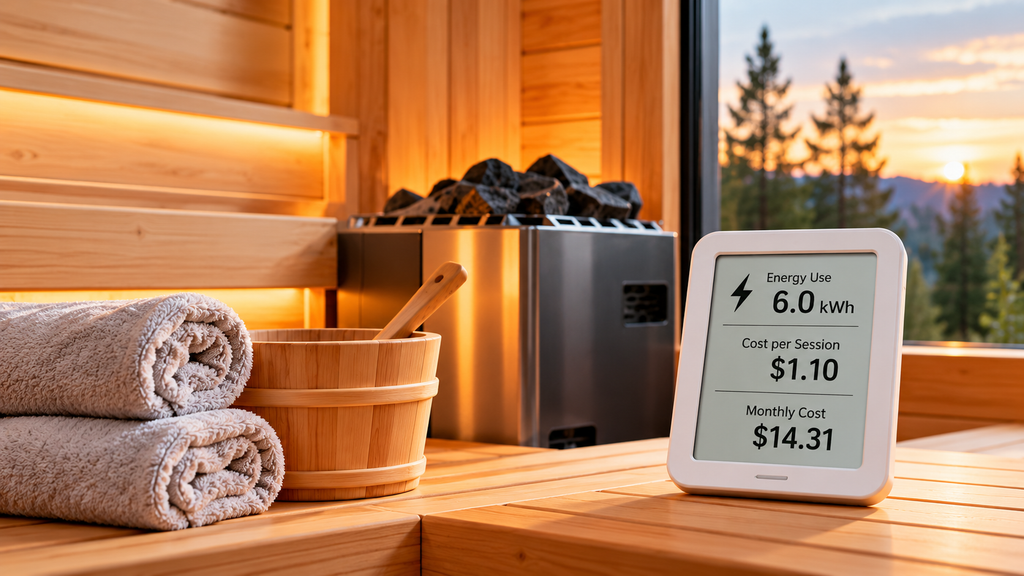
A simple upper-bound calculation is heater power in kilowatts × hours of operation × electricity price per kilowatt-hour. At 18.34¢/kWh, a 6 kW heater drawing its full rated power for one hour would cost about $1.10. An 8 kW heater at full power for one hour would cost about $1.47.
That does not mean a 6 kW sauna always uses exactly 6 kWh every hour. Rated heater power tells you the maximum electrical load when the heating elements are energized. Once a traditional sauna reaches its set temperature, its thermostat can cycle the heating elements rather than holding them continuously at full output. Room construction, outdoor temperature, ventilation, glass area, heater controls and how often the door opens can all change actual consumption.
Sauna Electricity Cost Examples
The table below shows the conservative cost of one hour at full rated power using 18.34¢/kWh. It is useful for comparing heater sizes, but it should not be mistaken for measured household consumption.
| Rated power | Energy at full power for 1 hour | Cost at 18.34¢/kWh |
|---|---|---|
| 2 kW | 2.0 kWh | $0.37 |
| 3 kW | 3.0 kWh | $0.55 |
| 4.5 kW | 4.5 kWh | $0.83 |
| 6 kW | 6.0 kWh | $1.10 |
| 8 kW | 8.0 kWh | $1.47 |
| 9 kW | 9.0 kWh | $1.65 |
| 10.5 kW | 10.5 kWh | $1.93 |
| 12 kW | 12.0 kWh | $2.20 |
If your utility charges 30¢/kWh, those costs are roughly 64% higher. If you pay 12¢/kWh, they are roughly 35% lower. That is why your own electricity rate matters more than a national average.
The Formula Behind the Calculator
Electricity is billed in kilowatt-hours (kWh). A 6 kW heater operating at full output for 30 minutes uses 3 kWh: 6 kW × 0.5 hour = 3 kWh. Multiply the energy by your electricity rate to estimate the cost.
For a traditional electric sauna, it is useful to separate the session into two phases: warm-up and time at temperature. During warm-up, the heater may spend much of the time at full output. After the room reaches the thermostat setting, the elements can cycle on and off. The calculator therefore gives you both a conservative full-power number and an adjustable operating estimate.
The adjustable percentage is not a universal efficiency rating. It is simply a scenario input that lets you model cycling after warm-up. If you want the most conservative result, set it to 100%. If you have measured energy consumption with a suitable energy monitor, you can use that information to refine your estimate.
Traditional Sauna vs Infrared Sauna Running Cost
Traditional electric sauna
Traditional electric sauna heaters commonly have higher rated power because they heat the room, stones and surrounding surfaces to sauna temperatures. The warm-up period is therefore an important part of the energy calculation. Heater sizing also matters: an undersized heater may run for longer, while an appropriately sized heater can bring the room to temperature as intended.
Infrared sauna
Infrared cabins generally use lower total electrical power and usually require less preheating because the emitters are designed to transfer radiant heat toward the occupants rather than first heating a large mass of sauna stones and the entire room to traditional-sauna temperatures. Actual wattage varies by model, so use the rated input shown on the sauna’s specification label or manufacturer documentation.
A lower rated wattage does not automatically make one sauna type ‘better.’ Traditional and infrared saunas provide different experiences, temperature ranges and heating methods. Compare operating cost alongside the type of sauna experience you actually want.
What Has the Biggest Effect on Sauna Running Cost?
1. Electricity rate
Your utility rate is one of the biggest variables. EIA data show substantial state-to-state differences in residential electricity prices, so a generic national figure can be misleading for an individual household. Check the energy charge on your utility bill and enter it in cents per kWh.
2. Heater power
A larger heater can draw more power while its elements are energized. But heater size should be matched to the sauna rather than deliberately undersized to save electricity. Use our Sauna Heater Size Calculator to estimate the capacity your room requires, then verify the final selection against the heater manufacturer’s instructions.
3. Warm-up time
Long warm-ups increase energy use. Harvia describes electric heaters as temperature-controlled equipment and provides controls that maintain the selected sauna temperature. How quickly the room reaches that temperature depends on the heater, room volume and construction.
4. Insulation and cold surfaces
Poor insulation and large areas of glass, masonry or other uninsulated surfaces increase the heating load. That can affect both the heater size required and how hard the system must work to maintain temperature. This is one reason our heater-sizing guidance accounts for room construction rather than relying only on floor area.
5. Indoor vs outdoor installation
An outdoor sauna can face colder starting temperatures and greater weather exposure than a conditioned indoor sauna. Climate, insulation and construction quality can therefore have a noticeable effect on warm-up and heat loss.
6. Session frequency
Even a relatively inexpensive session becomes a larger annual number if you use the sauna every day. The calculator converts your per-session estimate into weekly, monthly and annual costs so you can see the effect of frequency immediately.
How to Estimate Your Sauna Cost From Your Electric Bill
Find the electricity rate on your latest utility bill. If the bill shows dollars per kWh, enter the equivalent cents per kWh in the calculator. For example, $0.18/kWh equals 18¢/kWh.
Some bills include fixed monthly charges, taxes, demand charges or tiered/time-of-use pricing. A simple calculator cannot reproduce every utility tariff. For incremental sauna cost, the most useful input is usually the marginal per-kWh price that applies to the additional electricity you consume. If your rate changes by time of day, run the calculator with the rate that applies when you normally use the sauna.
Can You Reduce Sauna Electricity Cost?
Yes, but the goal should be reducing wasted heat rather than compromising heater sizing or safe operation. Start with good insulation and vapor-barrier construction, minimize unnecessary door opening, use the sauna when it is ready rather than leaving it hot for long unused periods, and follow the heater manufacturer’s ventilation and control instructions.
Do not reduce ventilation below the manufacturer’s requirements just to retain heat. Proper ventilation is part of sauna design, and the correct layout depends on the heater and ventilation method. Our Sauna Ventilation Guide explains those differences in more detail.
Does a Bigger Sauna Heater Always Cost More to Run?
Not necessarily in direct proportion to its nameplate rating. A larger heater has a higher maximum draw, but a correctly sized heater may reach temperature faster and then cycle. An undersized heater can struggle for longer. The right comparison is actual energy used in kWh over the full session, not simply the kW number printed on the heater.
That is also why this calculator shows both a full-power ceiling-style estimate and an adjustable operating estimate rather than pretending nameplate power equals continuous consumption.
How Much Does a Sauna Add to the Monthly Electric Bill?
For many home users, the monthly total is driven more by frequency and local electricity price than by a single session. As an illustration, the calculator’s default 6 kW example—45 minutes of warm-up, 30 minutes at temperature, 50% average heater output after warm-up, three sessions per week and 18.34¢/kWh—works out to roughly $14.31 per month.
That is an estimate, not a promise. A colder outdoor sauna, more glass, a higher thermostat setting, longer sessions or a higher electricity rate can increase the result. Better insulation, shorter warm-up, thermostat cycling and lower utility rates can reduce it.
Sauna Running Cost vs Purchase and Installation Cost
Electricity is only one part of sauna ownership. The initial sauna, heater, electrical work, foundation or room preparation and accessories can dwarf the first several years of electricity use. If you are planning the full budget, see our Home Sauna Cost Guide and 2026 Home Sauna Price Report in addition to this operating-cost calculator.
Frequently Asked Questions
How much electricity does a 6 kW sauna heater use?
At full output, a 6 kW heater uses 6 kWh per hour. Actual session consumption can be lower than simply multiplying 6 kW by the entire elapsed time because a thermostatically controlled heater can cycle after the sauna reaches temperature.
How much does it cost to run a 6 kW sauna for an hour?
At the June 2026 U.S. residential average of 18.34¢/kWh, one full-power hour would cost about $1.10. Use your own utility rate for a more relevant estimate.
Is an infrared sauna cheaper to run than a traditional sauna?
Infrared cabins often have lower rated electrical input and shorter preheat periods, so their electricity cost per session can be lower. The actual difference depends on the specific models, session length and local electricity rate.
Does a sauna heater run at full power the whole time?
Not necessarily. Electric sauna heaters use temperature controls, and the heating elements can cycle after the set temperature is reached. Warm-up conditions and heat loss determine how much time the elements spend energized.
Should I use the national average electricity rate?
Only as a rough example. Your utility bill is better. Electricity prices vary significantly by state, utility, rate plan and time of use.
Does a sauna need a dedicated electrical circuit?
Many electric sauna heaters require dedicated 240V circuits and hardwired installation, while some smaller infrared cabins use standard receptacles. Requirements depend on the exact equipment. See our Sauna Electrical Requirements guide and always follow the manufacturer instructions and applicable electrical code.
Bottom Line
Sauna running cost is easy to estimate once you separate power from energy. Kilowatts describe the heater’s electrical load; kilowatt-hours describe the energy you pay for. Enter your heater rating, electricity price, warm-up time and usage pattern in the calculator to estimate the cost per session and over a full year.
For planning a new sauna, use the result alongside the Sauna Heater Size Calculator, Sauna Electrical Requirements guide, Sauna Ventilation Guide, Home Sauna Cost Guide and Home Sauna Price Report. Together, those tools cover the major sizing, installation, purchase-price and operating-cost questions before you buy.