
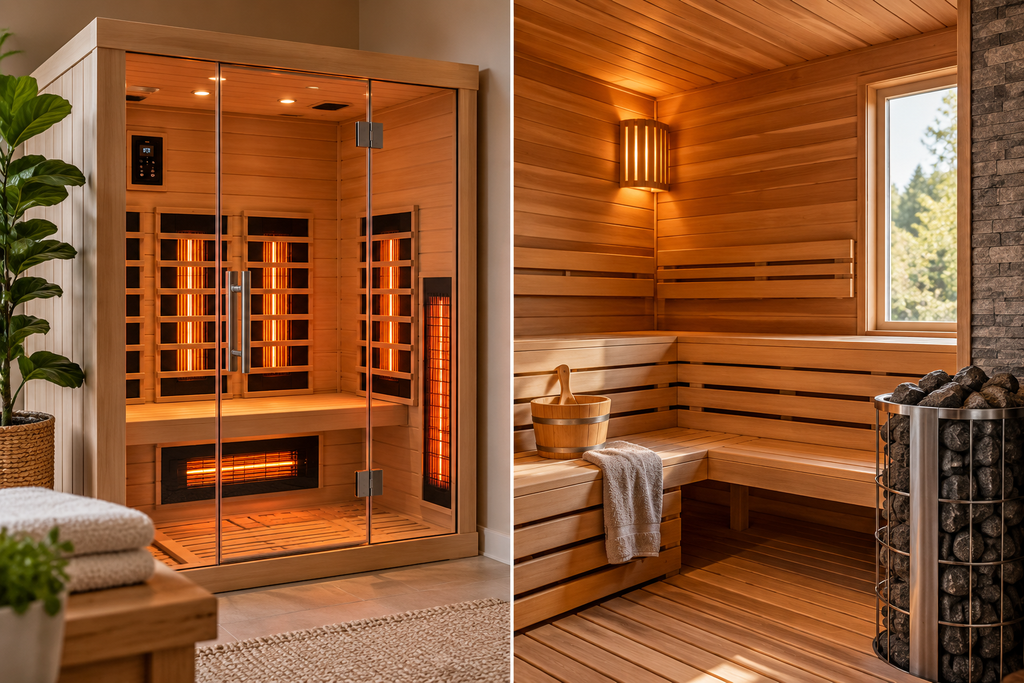
Infrared and traditional saunas can both give you a hot, sweat-inducing sauna experience, but they create that experience in very different ways. A traditional sauna uses an electric or wood-burning heater to heat stones, the room air and surrounding surfaces. An infrared sauna uses radiant emitters that transfer heat toward your body and the cabin surfaces while the surrounding air stays comparatively cooler.
That one difference affects almost everything a home buyer cares about: how the heat feels, whether you can pour water on hot stones, how long the sauna takes to get ready, the electrical setup, installation complexity and what you are likely to pay.
There is no single best type for every home. If you want high ambient heat and the classic water-on-stones sauna ritual, traditional has the advantage. If you prefer lower cabin temperatures and are attracted to the simpler electrical requirements available on many compact models, infrared may fit better. The right choice depends more on how you want to use the sauna than on which technology sounds newer.
Infrared vs. Traditional Sauna at a Glance
| Feature | Infrared sauna | Traditional sauna |
|---|---|---|
| How it heats | Infrared emitters provide radiant heat directed toward occupants and cabin surfaces. | A heater or stove heats stones, room air and surrounding surfaces. |
| Typical air temperature | Generally lower; current products commonly operate in roughly the 115–150°F range. | Generally higher; many home models operate roughly in the 150–195°F range. |
| Steam / löyly | Typical infrared cabins do not use a water-on-hot-stones system. | Suitable traditional heaters allow water on hot stones for löyly when used according to the manufacturer. |
| Warm-up | Often shorter because the entire room does not need to reach traditional-sauna temperatures. | Usually longer because the heater, stones and room need time to heat. |
| Electrical setup | Varies widely: some compact models are 120V, while larger models may require dedicated 120V or 240V circuits. | Electric traditional heaters commonly require dedicated 240V service; wood-fired systems have different installation requirements. |
| 2026 median advertised price* | $6,049.50 across 50 models in Sauna Handbook’s sample. | $6,936 across 63 models in Sauna Handbook’s sample. |
| Best fit | Lower-air-temperature radiant heat and potentially simpler installation on certain models. | Classic high-heat sauna experience with stones and löyly. |
*Price figures are from Sauna Handbook’s September 2026 analysis of 125 advertised home-sauna models. They are sample medians, not universal market prices or installed-cost estimates.
The Biggest Difference: How the Sauna Heats You
In a traditional sauna, the heater warms a mass of sauna stones and the surrounding air. The hot room then transfers heat to your body through a combination of convection and radiation. With a heater designed for it, you can pour a small amount of water onto the hot stones to create löyly — the burst of steam and perceived heat that is central to the Finnish-style sauna experience.
Infrared works differently. Instead of relying primarily on very hot cabin air, infrared emitters radiate energy toward your body and the interior surfaces. That is why an infrared cabin can feel intensely warm even when the thermometer shows a substantially lower air temperature than you would expect in a traditional sauna.
This distinction matters more than marketing labels. Someone who loves the enveloping heat, hot stones and löyly of a traditional sauna may find infrared fundamentally different. Someone who dislikes very hot ambient air may prefer the lower-temperature infrared experience.
Temperature: Infrared Is Cooler — but That Is the Point
Traditional and infrared saunas should not be compared by temperature alone because they deliver heat differently. Current manufacturer examples illustrate the gap: SunRay lists infrared operation around 120–150°F and traditional operation around 150–195°F. Clearlight’s guidance describes its infrared cabins as typically operating around 115–135°F during use.
Those figures are useful examples, not universal specifications. Maximum temperature and normal operating range vary by heater design, cabin size, controls, insulation and manufacturer. Always use the operating instructions for the exact sauna you buy.
The practical decision is simpler: choose traditional if you specifically want very hot room air and the classic sauna atmosphere. Consider infrared if you prefer a lower ambient temperature while still feeling strong radiant heat.
Warm-Up Time: Infrared Usually Gets Ready Faster
Infrared cabins often require less preheating because the goal is not to bring a large mass of stones and the entire room to traditional-sauna temperatures. Clearlight currently recommends roughly 10–15 minutes of warm-up for its infrared heaters, while current comparison material from SunRay lists about 10–15 minutes for infrared and 30–45 minutes for traditional.
Do not treat those numbers as promises. A sauna’s warm-up time changes with cabin volume, heater output, insulation, glass area, starting temperature and — for an outdoor sauna — weather. A large outdoor traditional sauna on a cold winter day can behave very differently from a compact indoor room.
If quick weekday sessions are important to you, warm-up time deserves real weight in the buying decision. If the ritual of heating the room and stones is part of what you want, the longer traditional warm-up may not feel like a drawback at all.
Electrical Requirements: Don’t Assume Every Infrared Sauna Plugs Into a Normal Outlet
One of the most repeated oversimplifications in sauna shopping is that infrared means ‘plug it into any household outlet’ while traditional means ‘hire an electrician.’ Reality is more nuanced.
Some compact infrared saunas do operate on a standard 120V/15A circuit. Others require a dedicated 120V/20A circuit, and larger or higher-output infrared models can require 240V. Current Clearlight specifications, for example, include both 120V and 240V residential models. Peak Saunas likewise lists models ranging from standard 120V/15A through dedicated 120V/20A and 240V configurations.
Traditional electric heaters commonly require dedicated 240V service, with the exact circuit determined by the heater and installation. That can add electrical work to a project if the required service is not already available near the sauna location.
Do not choose a sauna based on category alone. Check the exact model’s voltage, amperage, plug or hard-wiring requirements before ordering. For more detail, see Sauna Handbook’s Sauna Electrical Requirements guide. Electrical installation should follow the heater or sauna manufacturer’s current instructions and applicable requirements.
Infrared vs. Traditional Sauna Cost in 2026
Infrared has a reputation for being the cheaper option, but our 2026 market sample shows that the difference at the complete-sauna level is not as dramatic as that stereotype suggests.
In Sauna Handbook’s September 2026 analysis of 125 advertised home-sauna models, the 50 infrared models had a median advertised price of $6,049.50. The 63 traditional models had a median of $6,936. That is a difference of $886.50 between the two medians in our sample.
| Type | Models in sample | Median advertised price | Average advertised price |
|---|---|---|---|
| Infrared | 50 | $6,049.50 | $6,244.88 |
| Traditional | 63 | $6,936 | $7,782.29 |
| Hybrid | 12 | $7,709.50 | $7,572.85 |
Those numbers need an important qualification: advertised sauna price is not the same thing as installed, ready-to-use cost. Some traditional kits exclude the heater, controls, stones or freight. Site preparation and electrical work can add cost as well. Infrared packages also vary in what is included and what electrical preparation is required.
For the full methodology, price distribution and our separate audit of required equipment on traditional kits, see the 2026 Home Sauna Price Report. The useful takeaway here is not that infrared is always cheaper. It is that infrared was somewhat less expensive at the median in our sample, while individual products can overlap heavily in price.
Which Costs Less to Run?
Infrared saunas often use lower-power heating systems than full-size traditional electric sauna heaters, so they can use less electricity per unit of operating time. But there is no honest universal dollar figure for ‘infrared vs. traditional’ running cost.
Actual electricity cost depends on the equipment’s rated power, warm-up time, session length, how often you use it and your local electricity rate. A compact infrared cabin and a large traditional outdoor sauna are not meaningful one-to-one comparisons.
The clean way to compare two products is to calculate from their actual electrical load and your expected usage. Sauna Handbook will cover that separately in our sauna running-cost calculator rather than burying a generic estimate inside this comparison.
Steam and Löyly: Traditional Wins If This Is Part of the Experience You Want
If your picture of a sauna includes a bucket and ladle, hot stones and the rush of heat that follows a splash of water, you are describing a traditional sauna experience.
With an appropriate traditional heater, water added to heated sauna stones creates löyly. The room’s humidity rises temporarily and the heat can feel dramatically more intense even without a large change in the thermometer reading.
Typical infrared cabins do not reproduce that experience because they do not use the same hot-stone heating system. Never pour water onto infrared emitters or other sauna components unless the exact manufacturer explicitly instructs you to do so.
For some buyers, this single difference settles the decision. If löyly is non-negotiable, shop traditional. If you mainly want a convenient heated cabin and do not care about water on stones, infrared remains very much in the conversation.
Indoor vs. Outdoor: Both Types Exist, but the Model Must Be Built for the Location
You can buy both infrared and traditional saunas designed for outdoor use. You can also buy indoor versions of both. What you should not do is assume that an indoor cabin can simply be moved outside because the heating technology happens to be infrared or traditional.
Outdoor products need materials, weather protection, roof details, electrical provisions and manufacturer approval appropriate to outdoor exposure. If an outdoor installation is your goal, start with a product specifically rated for it. Our Best Outdoor Saunas and Best Outdoor Infrared Saunas guides narrow those choices further.
Maintenance Differences
Neither type is maintenance-free. Both need routine interior cleaning and care appropriate to the wood and components.
Traditional saunas add a few system-specific items: heater stones can deteriorate or settle over time, the heater needs inspection according to its manual, and repeated use of water means ventilation and moisture management matter. Infrared cabins typically eliminate the stone-heater maintenance step, but the emitters, controls, electrical components and cabin still need manufacturer-recommended care.
Whichever type you choose, following the manufacturer’s cleaning and maintenance schedule is more useful than relying on a generic claim that one technology requires ‘no maintenance.’
What About the Health Claims?
Sauna and passive-heat research is a legitimate and active field, but it is also an area where marketing often gets ahead of the evidence. Studies differ in sauna type, temperature, session duration, frequency and participant population, which makes broad product-specific conclusions difficult.
That is especially important when comparing technologies. Evidence associated with traditional Finnish sauna use should not automatically be treated as proof that every infrared product produces the same outcome, and manufacturer claims about infrared ‘detox,’ deep tissue effects or superior calorie burn should not be treated as established simply because they appear in marketing.
For a home buyer, the most defensible comparison is also the most practical one: heat style, temperature preference, steam and löyly, electrical requirements, installation, space, price and how often you expect to use the sauna.
Consider an Infrared Sauna If…
- You prefer lower ambient temperatures.
- You want radiant heat without the traditional water-on-stones ritual.
- You are shopping for a compact indoor cabin.
- You want to explore models that may work with an existing 120V circuit — while understanding that many infrared models still require dedicated or 240V service.
- A shorter typical warm-up is important to how often you will actually use the sauna.
Consider a Traditional Sauna If…
- You specifically want the classic high-temperature sauna experience.
- You want heated stones and the ability to create löyly.
- You enjoy the ritual and atmosphere of a conventional sauna.
- You have — or are willing to install — the electrical infrastructure required by your chosen electric heater, or you are considering an appropriate wood-fired setup.
- You are willing to trade a typically longer warm-up for the traditional heat and steam experience.
These are tendencies, not rules. Individual products vary considerably. Once you know which heat style you prefer, compare the exact models rather than buying based only on the words ‘infrared’ or ‘traditional.’
What About Hybrid Saunas?
Hybrid saunas are designed to combine more than one heating approach, commonly infrared emitters with a traditional-style heater or another dual-heat configuration. They can appeal to buyers who want flexibility, but the term ‘hybrid’ does not guarantee that every product delivers the same features.
Our 2026 dataset contained 12 hybrid models. Their median advertised price was $7,709.50 and their average was $7,572.85. That is a small sample compared with the infrared and traditional groups, so we would not use it to claim that all hybrids cost more.
If you are considering a hybrid, verify exactly what heating systems are included, whether it supports water on stones, what electrical service it requires and whether both systems can be used the way you expect.
Infrared vs. Traditional Sauna: The Bottom Line
The decision is less complicated once you ignore the marketing battle between the two technologies.
Choose based on the experience you actually want. Infrared gives you radiant heat at a lower cabin temperature and can offer simpler electrical installation on some models. Traditional gives you hotter ambient air, sauna stones and the option for löyly — the experience most people picture when they think of a classic Finnish-style sauna.
Price alone probably should not decide it. In our 2026 sample, the median infrared model was only $886.50 below the median traditional model, and installed costs can change the comparison.
If infrared sounds like the better fit, continue with our Best Infrared Saunas guide. If hot stones and löyly are what you are after, start with our Best Traditional Saunas for Home guide. And before ordering either type, verify the exact product’s space and electrical requirements.
Frequently Asked Questions
Is an infrared sauna better than a traditional sauna?
Neither is universally better. Infrared generally offers lower-temperature radiant heat and can have simpler electrical requirements on some models. Traditional offers hotter ambient air, sauna stones and löyly. The better fit depends on the experience and installation you want.
Which gets hotter: infrared or traditional?
Traditional saunas generally operate at substantially higher air temperatures. Current product examples commonly place infrared cabins around 115–150°F and traditional saunas around 150–195°F, but exact ranges depend on the product.
Which type is cheaper?
In Sauna Handbook’s September 2026 sample, 50 infrared models had a median advertised price of $6,049.50, compared with $6,936 for 63 traditional models. Installed cost can differ because equipment, freight, site preparation and electrical work vary.
Do infrared saunas use less electricity?
Many infrared cabins have lower rated power than traditional electric heaters, but actual energy cost depends on the exact equipment, warm-up time, session length, usage frequency and electricity rate.
Can you make steam in an infrared sauna?
Typical infrared cabins do not use the traditional water-on-hot-stones system. Never pour water on emitters or components unless the exact manufacturer specifically permits it.
Does an infrared sauna need 240V?
Not always. Some smaller models use 120V/15A, while others require dedicated 120V/20A, 120V/30A or 240V service. Check the exact model before buying.
Which type is better outdoors?
Purpose-built outdoor models exist in both categories. Use a sauna outdoors only when its manufacturer rates the model for outdoor installation.